one of my main philosophies in life has always been to try and accept people's differences and to let others be about their personal decisions, presuming they aren't acting in a way that negatively affects others. one of my favorite books, ishmael by daniel quinn, only reinforced this belief. it encouraged me to try and see the other perspective, among other things. however, i recently finished reading another book - eating animals by jonathan safron foer (mentioned in my last post) - that has me re-thinking my philosophy in regards to...well, eating animals.
as a backstory, i've been a vegetarian for the past 8 years now, since i was 15. i was the only vegetarian in my grade and, while there may have been others in my high school, i didn't know any. my being the odd one out at mealtimes didn't bother me in the sense that it was different, but i did feel like it was at times a strain on the people that i ate with. when i told my parents that i intended to stop eating meat, my mom took me to a nutritionist to discuss diet. it was one of the conditions that i had to meet in order for her to support my decision - the other being that i continued to eat eggs. my dad took a little longer to come around, initially not understanding my decision or why it wasn't ok to "just pick the meat off" off a pepperoni pizza and eat it (i'd like to follow that up by saying my dad now reserves a part of the grill when barbequing that he cleans and aluminum foils so that my veggie dogs don't get charred meat remains on them!). when i went on vacation twice with my friend & her grandparents the first summer of my vegetarianism, i ordered a salad every time we ate out (which is what i usually ordered anyway before i stopped eating meat) and her grandmother panicked that i was going lose too much weight and my parents would blame her for underfeeding me. at one point, she insisted the server give me two salads instead of one. and made me eat the whole enormous pile of greens. i've gone over friends houses who neglected to inform their parents of my eating habits and tried to politely pass the meat dishes by. if and when the parents noticed and i brought up my vegetarianism, it inevitably leads to an awkward, apologetic rush to find me more to eat than the vegetable side dishes and bread. when my family picks a restaurant to eat at, they always ask, "will lauren have something to eat there?" before heading out the door. moral of the story is, (while i greatly appreciate everyone's consideration of and my family's acceptance of my eating habits) i have always felt like that in the grand scheme of social eating habits that humans have, my particular preferences can be an annoyance for meat-eaters. & in accordance with my theories on life, i have never tried to push an herbivorous diet on anyone else. and that's where mr. safron foer comes in...
factory farming. it's this thing that goes on with the majority of our animal-derived foods (not even taking conventional agricultural practices into account here) that, in the very pushed-back-far-away-lets-not-discuss-this-i'm-trying-to-eat-here parts of our minds, we all know is happening. no one really wants to be reminded of it and, seeing as how i don't eat meat it's not something that i've ever concerned myself with very much. especially since other people's decision to eat meat isn't negatively harming me or others, right?
well...wrong. and that's where the revision in my life philosophy comes in. i'm not trying to tell people what to do here, but the fact of the matter is that when i look at it choosing to spend your dollar supporting and eating factory farmed meat is harming so many people and animals on so many different levels that few things compare to it. i'm going to try and illustrate this, but without going into depths about the particular cruelties that happen to the animals themselves. while the shock value of the treatment is moving, i find that people still manage to tuck that away and eat their meal without thinking of how the cattle ended up in steak-sized shape on their plate. so i will try to use other arguments that perhaps will be more moving in the meat aisle of the grocery store.
environmental tolls. first, you have to consider the land needed to grow the grade 2 corn that is needed to feed all of these animals (that, frankly, do quite poorly on a diet of corn and grains). for example, i found this disturbing statistic, "To create a meat-centered economy, 260 million acres of forest have been cleared for cropland". also, you have to water the crops and give the livestock water. 70% of the water used in the western states of the US goes to raising animals for food. and then once the food is watered, grown, processed, and carted off to feed the animals...they poop it out. into enormous pools of waste larger than multiple football fields put together and containing anything (not just waste) that fits through the slatted floors of the livestock facility. including body parts, to say the least of it. and when the waste doesn't just disappear, they sometimes just shoot streams of it into the air to dissipate. shit geysers, if you will. more on this later...& check out this alarming stat - remember the exxon valdez oil spill? yeah, 12 million gallons of oil spilled in the Prince William Sound; it is considered one of the top-ranking disasters caused by humans ever to occur at sea. well, there was a less publicized incident in north carolina where 25 million gallons of hog feces/urine were spilled into local waterways when an 8 acre lagoon under the supervision of Smithfield Foods (who also owns Butterball), polluting the area and water supply with contaminants as well as devastating the aquatic life (science sidenote: in addition to it being both GROSS and disease-causing to have a river full of poop, the high nitrogen content in feces is fodder for algae. when there's that much available, there are big algal blooms that cover the surface of the water, blocking out sunlight and killing off aquatic plants and other phototrophs. as you can imagine, that puts a real damper on the food chain). and the fines Smithfield was charged for the 20,000 citations and ecological devastation? the same amount of money (12 million) that they gave their CEO in stock options in that year. not they are an ~$12 BILLION company. the industrial agriculture industry has also surpassed all others as the #1 cause of pollution in the US, part of that being due to their exhorbitant consumption of fossil fuels used in running the stockyards and processing plants.
human health - growing animals for meat in the corporate/factory model means that you need to accelerate growth and get as much output as possible with as little input/investment as possible. what this boils down to is cheap food, abnormal growth, and crowded conditions. only this isn't a pair of cheap pants that we're buying - it's the food that we're putting into our bodies. there are a complete of very important consequences of this model of business. for starters, cheap corn isn't a good food source for a ruminant. pigs, cattle, and poultry just barely get by eating it and it means that they COULDN'T live much longer than the short amount of time we allocate them - despite the creation of genetically malformed livestock that has evolved to suit the desires of our eaters (we like big breasts on chicken as well as women in the US). close quarters and limited (if any) mobility only make it worse, and so we give them preventative antibiotics to keep them healthy enough for a good amount of them to survive long enough for them to be killed. the same antibiotics that we carefully allocate to sick humans to try and prevent widespread antibiotic resistance. sick humans are given 3 million lbs of antibiotics per year in the US. on the other hand, 24.6 millions lbs of antibiotics are given to livestock per year for reasons other than disease. and i don't know how much good all those antibiotics do when, in the course of processing, sick-ish animals are slaughtered and processed (70% of factory farmed pigs have pneumonia at slaughter, 90% of chickens have cancer) and then the meat is likely to have feces or some other contaminant splashed on it in processing.
and quick growth like that means that you're not getting the leanest meat. eating fatty foods isn't exactly a good way to lose weight and that chicken on your plate didn't get so big so fast by pumping iron. also, the large amounts of corn we're consuming these days both directly and indirectly (like eating the things that ate the corn) has lead to a disproportionate amount of omega 6 fatty acids over omega 3's - a possible cause for all of the heart disease the US population is suffering from. and back to the fountains of
animal welfare - like i said, i'm not going to go into details here. i think we all know that animal welfare is pretty much non-existant in a factory livestock environment. i will say one thing, though - it strikes me that factory farms are like pig/cattle/poultry concentration camps. when you give a human being all of the power over a weaker and defenseless creature, the power corrupts. if it's your job to kill and the emphasis is on speed and efficiency over the value of life and appreciation for the animal that is giving it's life to sustain you...people are prone to do some terrible things.
one of the most horrifying things that i read in "eating animals" didn't have to do directly with the consumption of meat, but rather the regulatory body dealing with the foods we eat. as it turns out, in addition to regulating our foods supply, the USDA has a second (less talked about) purpose - to protect food producers. in this day and age, that essentially means large corporations with powerful lobbyists. so when the USDA approves meat with campylobacter for consumption and makes dietary recommendations that suggest we eat so many servings of meat per day, keep in mind that it is not their singular job to protect the consumer. it is their job to both regulate food production and protect the factory farm conglomerate. we eat nearly double the amount of meat that people ate in the 50's for no reason other than we can and think we should. the atkin's and other protein-crazed diets didn't help with this trend - am i surprised that mr. atkins himself suffered from heart disease? no.
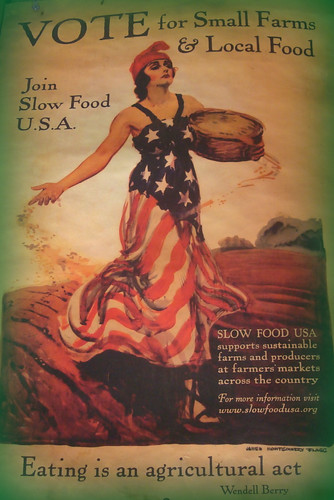
so to conclude this post, i would ask my readers (ahem...mom) to consider a few things. first and foremost, i would like to quote wendell berry's famous adage that, "eating is an agricultural act". what we choose to eat directly impacts the way that livestock is raised (and slaughtered) in this country. i am not longer content to be quiet and allow factory farmed meat consumption to go on around me without having my say, thereby supporting the industry by proxy. while pasture-raised poultry may appear to be more expensive than what Butterball crapped out, the reality of it is that Smithfield Foods externalizes the costs of their birds through environmental devestation, disease, abuse of antibiotics, and health risks for their consumers."the price of meat would double or triple if full ecological costs - including fossil fuel use, groundwater depletion and agricultural-chemical pollution - were factored in," says Earthsave in a 1997 publication. so while it be cheaper by the pound in the one sense, your money is much better spent supporting a different food source. i urge you to consider both decreasing the amount of meat consumed as well as sourcing meat from more accountable sources. and i wouldn't worry much about not getting enough protein - despite what the USDA has to say about it, we actually need very little protein. in fact, some studies show that diets high in protein can lead to a higher likelihood of osteoporosis and kidney disease.
for my part, i will be trying to source better meat producers for the cafe that i work at and, while i would never ask my family to not have a turkey for thanksgiving dinner, i hope they'll work with me to find a new jersey turkey to join us at dinner that lived a decent life outdoors before ending up on the table. for those in the boston area looking for local, better food sources my new favorite website is bostonlocalvores.org. it is an excellent source for CSAs (community shared agriculture - you pay the farmer up front and are guaranteed a share of local, responsibly farmed product whether it be grain, honey, meats, eggs, flowers, or the more conventional produce), stores and restaurants that carry and serve locally sourced goods, farm markets, events, and lectures. on february 18th in JP the hardwick beef farmer will be coming to talk about his grass-fed beef. for those not in the boston area, localharvest.org is a great place to find CSAs, farmers markets, and farms in your area. you can search by area code and you can also search by product!
i will close with my new favorite poster, put out by slow food usa and using the aforementioned wendell berry quote. slow food usa is a nonprofit that advocates for supporting local, sustainable agriculture and are a big force promoting the use of heirloom varieties - nearly extinct species of plants and livestock - that help combat the monoculture of today's agricultural landscape (and taste amazing, too!).

No comments:
Post a Comment